The Drinks Trust is committed to conducting its work legally, ethically, and with the highest standards of honesty and integrity. We expect these principles to be upheld by our staff, trustees, applicants, and grant recipients. The Charity actively promotes an anti-fraud culture and prioritises the prevention of fraud.
We have established robust safeguards to protect our grants from fraud. As part of these measures, we reserve the right to request sufficient supporting evidence to meet our requirements, verify information, and address any concerns regarding false, inconsistent, or missing details.
Our safeguards include
- Training staff to identify fake or fabricated documents.
- Verifying the existence and legitimacy of organisations and individuals named in applications or communications.
- Each case is assessed on its own merits. The following section outlines the actions we will take under different circumstances.
However, given these complexities, issues can arise. This document outlines the actions The Drinks Trust will take in such cases. Each situation will be assessed individually.
The Drinks Trust will:
- Investigate all suspected incidents of fraud.
- Report any potential or actual fraud involving individuals or organisations to the Charity Commission.
- Where evidence exists, report attempts to defraud the Charity to Action Fraud and the Police.
- Take appropriate steps to recover misused funds.
What It Means and What We Will Do
Fraud refers to any act of deception intended to deprive, disadvantage, or cause loss to another person or organisation, or to secure an unwarranted personal gain. This can include theft, misuse of funds or resources, or more complex offences such as false accounting and providing false information.
Fraud is a criminal offence, defined under the Fraud Act 2006, which sets out the legal framework for prosecution. Under this Act, fraud can be committed in three primary ways:
- fraud by false representation
- fraud by failing to disclose information
- fraud by abuse of position
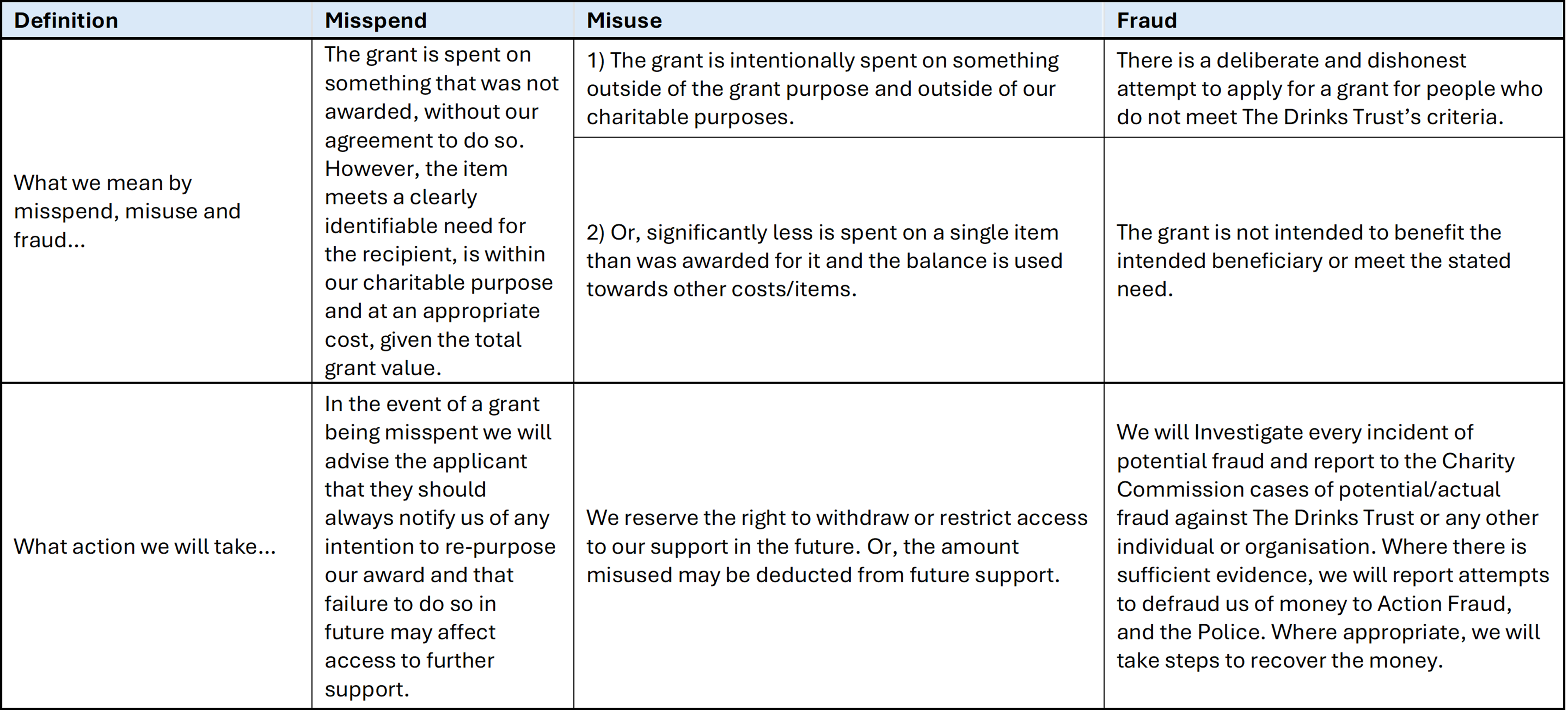
Individuals can be prosecuted under the Fraud Act 2006 if they make a false representation, fail to disclose information or abuse their position. However, we understand that there are circumstances where funds are mispent or misused, but that do not necessarily meet this definition of fraud. Below is a description of how we differentiate these and the resulting differences in our response.